PROTACs and molecular glues
Designing productive complexes for PROTACs and molecular glues
Productive protein recruitment depends on geometry, cellular context, and the steps after ternary-complex formation.
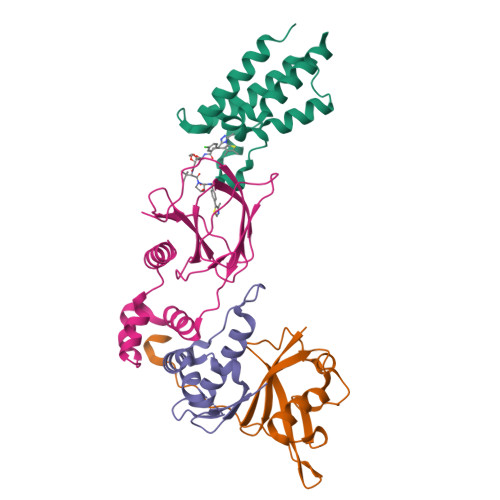
A PROTAC can bind its target and its E3 ligase separately yet show little degradation in cells. The ternary complex may be unfavorable, the compound may not reach sufficient intracellular concentration, or the assembled system may fail to support productive ubiquitination. Binary affinity measurements leave several of these possibilities unresolved.
Recruitment introduced a different design problem
PROTACs developed by connecting a target-binding ligand to a ligand that recruits an E3 ubiquitin ligase. The linker allows the compound to bring the proteins together. Molecular glue degraders can instead stabilize a protein interaction through a compact ligand-dependent interface, without the same two-headed architecture.
Structural studies made the resulting protein contacts directly accessible to design. Gadd and colleagues solved the MZ1 complex with BRD4 and VHL, showing how induced interactions between the proteins contributed to cooperative recognition and selective degradation [1]. The linker and protein surfaces participate in the complex together, so optimizing either binary ligand in isolation can miss important determinants.
Molecular-glue work on CR8 provided a different example. The compound promotes recruitment involving CDK12–cyclin K and DDB1, leading to cyclin K depletion [2]. This mechanism demonstrates why a protein-binding compound can acquire a degradation effect that is not apparent from its original inhibitor annotation.
Generate plausible assemblies
For a PROTAC, begin with reliable target-ligand and ligase-ligand structures where possible. Enumerate relative protein orientations compatible with linker reach and chemistry. Reject severe clashes and strained linkers, then inspect the protein interface. Several distinct assemblies can remain plausible even when the binary binding poses are well supported.
Sampling and scoring need to reflect linker flexibility and protein motion. A single minimized pose gives little information about the population of productive states. Cooperativity measurements and structural restraints can help narrow the possibilities. Candidate models should also be examined in the context of the larger ubiquitination machinery; proximity to a ligase-binding domain alone does not establish access to an appropriate substrate lysine.
For a glue series, the binding surface created by the ligand becomes part of the design problem. Analogs should be evaluated for their effects on the recruited interface, not only their affinity for the initial binding partner. A substituent with little effect on enzyme inhibition can still change degradation activity.
Plan assays that locate the failure
Measure target abundance across concentration and time, including recovery after washout where relevant. Compare cellular engagement, ternary-complex behavior, and degradation rather than assuming one endpoint predicts the others. High-concentration loss of degradation can be consistent with a hook effect, but other explanations should be checked before assigning that mechanism.
Genetic perturbation of the recruited machinery, proteasome-dependence experiments, and proteomic selectivity measurements can help establish the route to protein loss. Changes in synthesis or nonspecific toxicity can otherwise resemble degradation in a single abundance assay.
Use the model to select linker changes or interface substitutions expected to alter a measurable step. If binding is retained but degradation changes, that is useful evidence about the assembled system. The next iteration should investigate that difference before spending chemistry effort on another improvement in binary affinity.
References
- Gadd et al. Structural basis of PROTAC cooperative recognition for selective protein degradation. Nature Chemical Biology (2017).Experimental structure and biophysical evidence for a cooperative ternary complex.
- Słabicki et al. The CDK inhibitor CR8 acts as a molecular glue degrader that depletes cyclin K. Nature (2020).Mechanistic and structural evidence for a molecular glue degrader.
- Design principles for cyclin K molecular glue degraders. Nature Chemical Biology (2023).A broader chemical and structural examination of the induced interface.