Protein-ligand modeling
Building a protein-ligand complex that can guide chemistry
Preparation, pose selection, and experimental restraints determine whether a complex is useful for design.
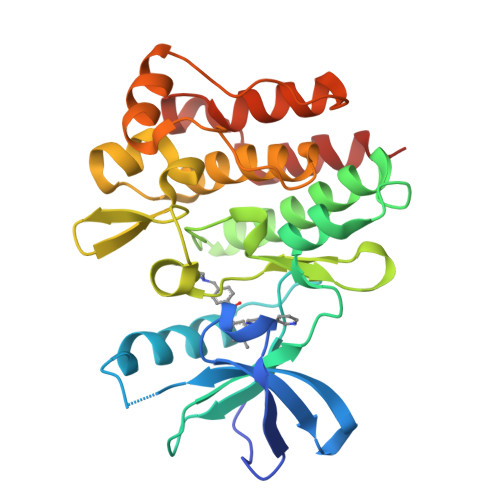
A docking run can place a ligand neatly inside a pocket and still produce the wrong complex. The ligand may have the wrong protonation state, a side chain may block the relevant conformation, or a buried water may have been removed without justification. These preparation decisions can change the chemistry recommendation as much as the docking algorithm.
Establish the biological starting structure
Inspect the protein sequence, construct, mutations, and assembly. An experimental structure of the exact target is useful, but its state may be unsuitable for the ligand class. A kinase bound to one inhibitor can present a different pocket from the state required by another. Check missing residues, alternate conformations, metals, cofactors, and the quality of the local experimental evidence.
For a predicted structure, distinguish confidence in the global fold from confidence in the binding site. A model with a convincing domain structure may still have an uncertain loop or side-chain arrangement at the pocket. If several experimental or predicted conformations are plausible, retain a small ensemble and document why each is included.
Docking developed to search poses efficiently
Docking methods combine a search procedure with an approximate scoring function. Their practical development addressed the need to explore many ligand orientations and conformations at a cost compatible with screening. AutoDock Vina introduced an efficient optimization approach and scoring function that made this workflow accessible for many applications [1]. The score remains an approximation; it does not convert a pose into experimental evidence of binding.
Prepare chemically plausible ligand states at the relevant pH, including stereochemistry and tautomers. Re-docking a known ligand can test whether a setup can recover its pose. Cross-docking into other structures tests a different and often more demanding problem. Neither exercise alone establishes that the same protocol will rank a new chemical series by affinity.
Compare explanations of the existing data
Inspect pose clusters rather than only the top-scoring result. Check buried polar groups, ligand strain, metal coordination, and steric contacts. Distinguish an interaction that persists across plausible models from one that depends on a single uncertain side chain. Water-mediated contacts need an explicit rationale for retaining or displacing the water.
Known structure-activity relationships can help choose among poses. If a model predicts that a substituent points into a narrow pocket, tolerance of much larger groups needs explanation. Avoid forcing every observation into the favored pose; an alternative binding mode or assay mechanism may fit better.
Molecular dynamics can test local relaxation and examine interaction persistence under a defined model. A stable short trajectory does not prove that the initial pose is correct, because the simulation may remain near its starting basin. Independent starts and alternative poses make that limitation easier to examine.
Deliver a model with a discriminating experiment
Joint structure-prediction methods such as AlphaFold 3 offer another source of candidate complexes [2]. They should enter the same process of chemical inspection and experimental comparison.
For chemistry planning, provide the leading pose, credible alternatives, and the assumptions that separate them. Propose an analog or mutation expected to produce different outcomes under those alternatives, while accounting for possible effects on protein stability. The most useful complex is one that helps the team choose an experiment and can be revised when that experiment disagrees.
References
- Trott and Olson. AutoDock Vina: improving the speed and accuracy of docking with a new scoring function, efficient optimization, and multithreading (2010).Primary docking-method paper; useful for understanding the search-and-score approach.
- Abramson et al. Accurate structure prediction of biomolecular interactions with AlphaFold 3. Nature (2024).An alternative source of candidate biomolecular complexes.